
Equivalent Exchange and the Cost of Power
Humankind cannot gain anything without first giving something in return. To obtain something, something of equal value must be lost. That is Alchemy’s First Law of Equivalent Exchange.
This is how Alphonse (Al), the younger brother of Edward (Ed) Elric, explains Equivalent Exchange. It is the fundamental law of the world of alchemists, where they use the scientific art of manipulating matter through understanding, deconstruction, and reconstruction. When you think about it, it actually makes sense, because in real life we are always taught that in order to get something, we have to give something in return. This is not only true for material possessions; even experience requires time and effort as a form of payment.
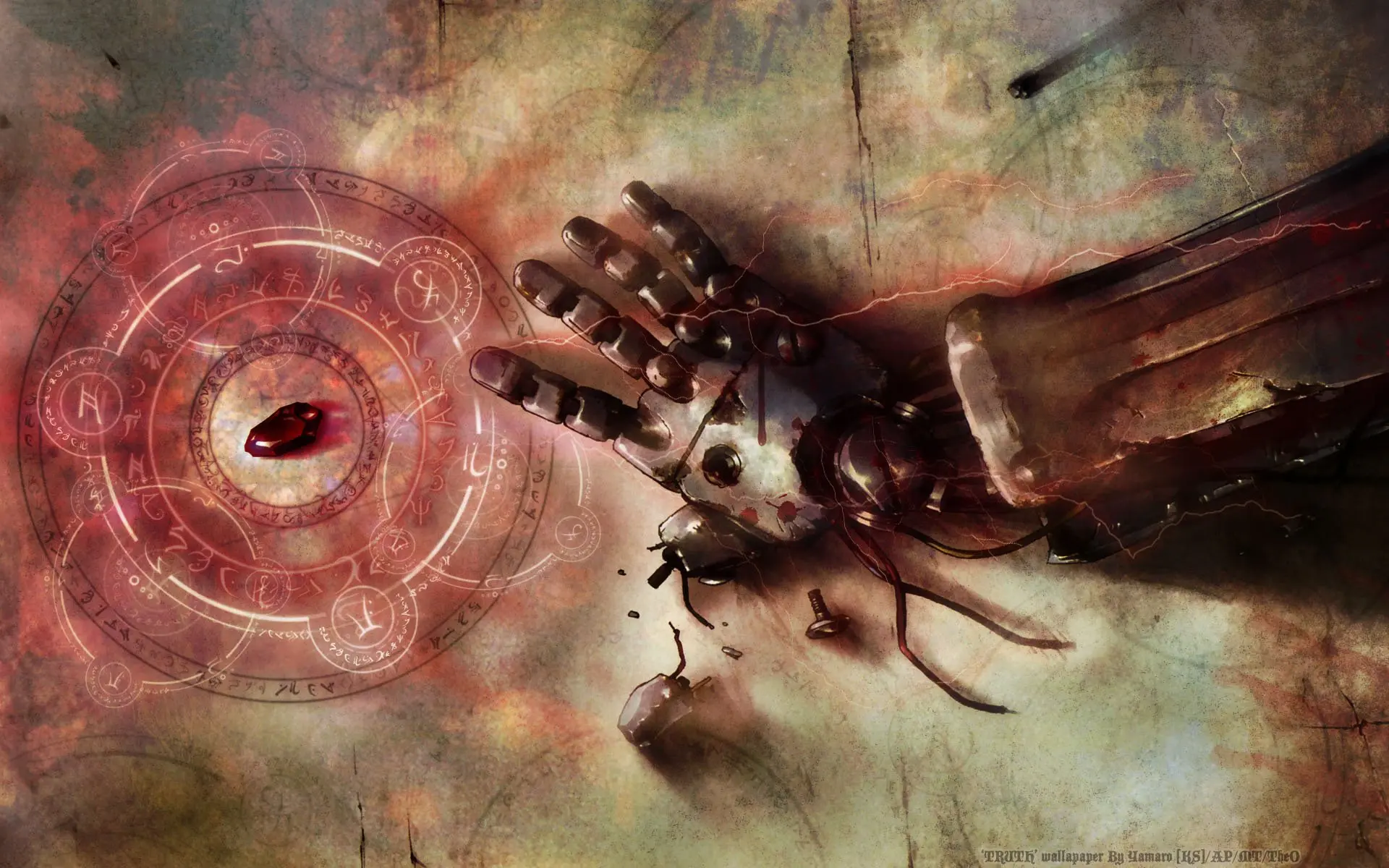
At the beginning of the series, Ed and Al, while they are still children, try to bring back their mother, Trisha, who passed away from a fatal illness. They calculate the components of a human body—water, carbon, and other elements—and attempt to reconstruct her. As children, they believe that these ingredients are enough to create a human being, but they are not. Ed loses his arm, and Al loses his entire body. However, what they create does not resemble their mother at all. It appears as a lifeless, monstrous form that cannot survive. This moment shows that something essential is missing, something that cannot be measured or calculated.
This brings us to another law of alchemy: human transmutation is forbidden. You can create a sword by reconstructing materials, but can the same logic be applied to a human? Humans are not just physical bodies; they also have knowledge, emotions, and a soul. If Equivalent Exchange is based on balance, then what is the value of a soul? And more importantly, is it even possible to measure it?
After losing everything, Ed desperately tries to save his brother. This time, he sacrifices his leg to bind Al’s soul to a nearby suit of armor. In this moment, he briefly encounters a mysterious entity known as Truth, standing before a gate that represents absolute knowledge. Truth seems to know everything, but it never gives anything away for free. This experience suggests that the more knowledge or power someone seeks, the greater the price they must pay. Power, in this world, always comes with a cost—and often, that cost is far greater than expected.
This idea is not limited to the world of alchemy. In real life, people also want to achieve things, but many look for shortcuts. They search for easy wins, even though deep down they know that real progress requires sacrifice. For example, some people rely on luck, such as lottery tickets, hoping to gain something without giving much in return. However, this rarely works. The same applies to knowledge and personal growth: they require time, effort, and sometimes failure. In this sense, Equivalent Exchange reflects a truth about reality—but it also raises a question: is the exchange ever truly equal?
What do you think about Equivalent Exchange? Is it really enough to give one thing to gain another, or do we sometimes have to give more than we expect? In the following posts, we will explore how the series challenges this idea and whether this “law” truly holds.
Enjoyed this? Leave a comment below.